Native Flower Gardening in Virginia — My “New” Philosophy

I’ve decided I’m going to have a new native garden philosophy!  I’m going to give up on weeding!  Or at least I’m not going to try to dig up wire grass anymore.  To dig it up requires using a spading fork and this basically destroys my garden.  Here’s a photo of where I dug up wire grass last fall:

Where Wire Grass Dug Up

Where Wire Grass Has Been Dug Up

It’s not worth it.

I know of more than one native flower garden in nearby City parks that has been abandoned because the gardener couldn’t control the wire grass.

I’ve found that wire grass is relatively unsuccessful in the vicinity of my tall flowers such as Monarda fistulosa, sweet Joe Pye Weed, goldenrod and green-headed coneflower.

My new philosophy is going to be to plant as many tall-ish flowers as close together as possible and ignore the wire grass.  I’d like to say I’m aiming for a Flower-rich Meadow but this is too euphemistic!  I’m going to have to say I’m aiming for a Flower-rich Mess and if the bees like it, then I like it.

In the interests of truth-in-advertising, here’s a photo of what my flower-rich mess looks like right now.  (Not exactly flower-rich right now but hopefully there will be a big transformation over the next few months.)

Current State of Flower-rich Mess

Current State of Flower-rich Mess
Signs of Spring in Virginia

Here are some pictures of early springtime in Virginia.

Serviceberry Coming into Bloom Photographed 04/03/15

Serviceberry Coming into Bloom Photographed 04/03/15

Monarda fistulosa Photographed 03/15/15

Monarda fistulosa Coming Up Photographed 03/24/15

Redbud Flower Buds Photographed 03/22/15

Redbud Flower Buds Photographed 03/22/15

Spicebush  in Bloom Photographed 03/28/15

Spicebush in Bloom Photographed 03/28/15

Dogwood Flowers Opening Up

Dogwood Flowers Opening Up Photographed 04/03/15

Native Honeysuckle Leafing Out Photographed 03/24/15

Native Honeysuckle Leafing Out Photographed 03/24/15


Green-headed Coneflowers Continue to Work Their Magic

Although they are well past blooming and practically all petals have dropped, the green-headed coneflowers are still acting as a food source. Yesterday I tried to get a picture of a goldfinch in these flowers with my smart phone, but was unable to do it.  This morning I went armed with my “real” camera, and was able to get this picture with the lens zoomed to its  limit.

Goldfinch in Green-headed Coneflower

Goldfinch in Green-headed Coneflower

Now It’s Green-headed Coneflower Time in Virginia

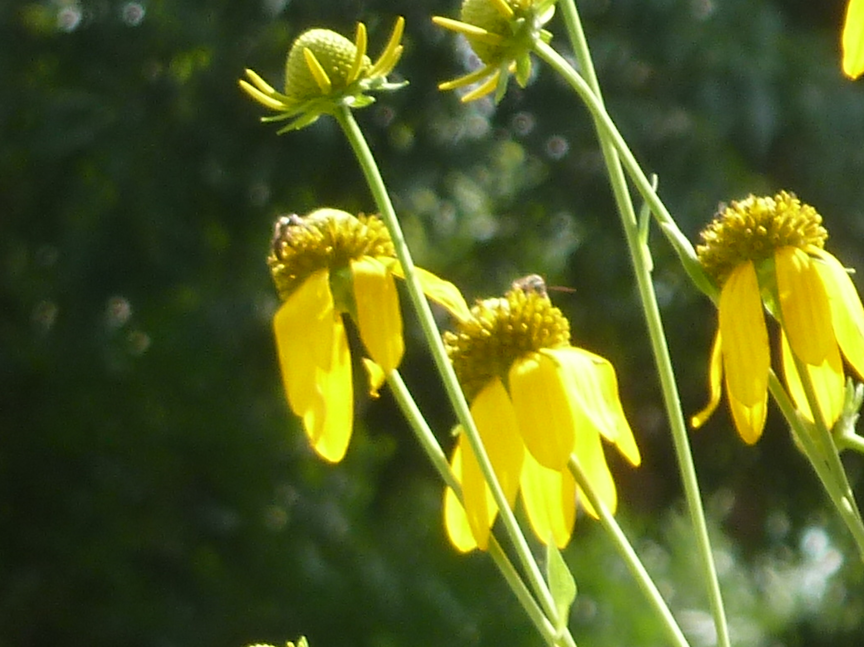
At last (late July – early August) the green-headed coneflowers (GHCF) — Rudbeckia lacinata — are blooming.

By now (08/01/14) the spring bloom of the garden is almost totally gone. The boneset is blooming throughout and the GHCF are standing tall at the back.  (In another post I’ll discuss the current “weedy” state of the garden.)

The Garden as of 08/01/14

The Garden as of 08/01/14

Whereas the Monarda attracted large bees, the GHCF attacts tiny bees. Here’s a view of the GHCF closer up in late July.  Although there are a swarm of insects on the flowers, you can’t make them out in this photo.

Green-headed Coneflower Closer Up

Green-headed Coneflower Closer Up

In this REALLY close-up view, not quite in focus, you can see 3 little bees if you look carefully.

Close-up with 3 Tiny Bees

Close-up with 3 Tiny Bees

Finally, in this short video, you can see some bees buzzing around the flowers (you may need to watch it a couple of times to be sure to catch the bees — if you’ve ever had a visual field test this is a little bit like that):


A Gossamer Winged Beauty

Today I took a walk around my garden to see what I could photograph.  When I got to the goldenrod, I saw a butterfly.  Butterflies have been extremely scarce this summer so I immediately tried to get a picture of this one, though I didn’t know its identity.  When I looked at the photo on my computer, this is what I saw:

Olive Hairstreak on Goldenrod

Olive Hairstreak on Goldenrod

According to my Audubon Society Field Guide to North American Butterflies, this is an Olive Hairstreak in the category of “Gossamer Wings.”  It’s host plant is Eastern Red Cedar.  I am fortunate to have a couple of those trees in my yard. — Robin