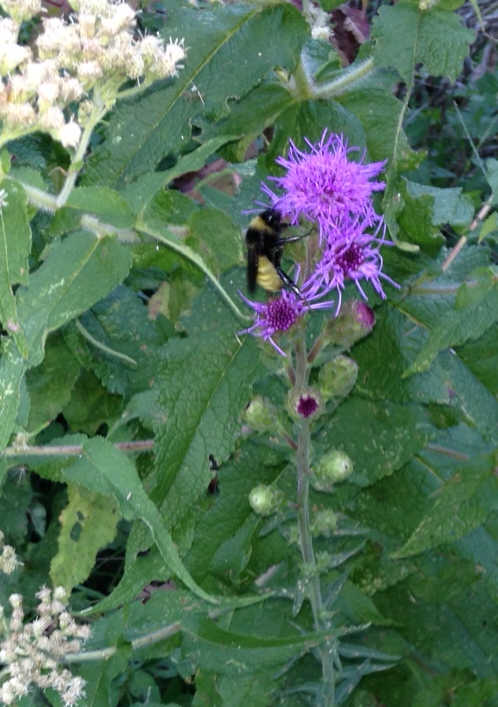
This spring I planted some bare root Northern Blazing Star — Liatris scariosa. It has come up strong and is just now starting to bloom. Last evening I saw that a bumblebee had already found it:
Bumblebee on Northern Blazing Star
Undoubtedly there will be more pictures to follow.
My sneezeweed has been coming into bloom for a couple of weeks now.
Sneezeweed
I count at least 7 tiny bees in this photo.
You can understand why its Latin name is Helenium autumnale. Most of my other flowers are done blooming for the year. Next year I plan to plant a lot more sneezeweed throughout my “meadow” garden so there will be more late summer color and nectar source for the tiny solitary bees.
Late afternoon the day before yesterday, I was walking around my garden when what should I see, but a large orange butterfly. I immediately thought it might be a Monarch as it seemed too large to be a Painted Lady. It must have flitted around and through the garden for a good 10 – 15 minutes before it finally rested with its wings open in a spot where I could get a photograph.
Male Monarch Butterfly
It was clearly a male Monarch butterfly.
I was amazed to find him again, yesterday — 24 hrs. later, still in the garden. I keep fantasizing that he’s feeling that he has found a spot where the world is as it ought to be. There still seem to be plenty of nectar flowers available — boneset, goldenrod and a butterfly bush. Plus there’s plenty of milkweed should a female arrive to lay eggs. (I wish this male could somehow get a female to join him.)
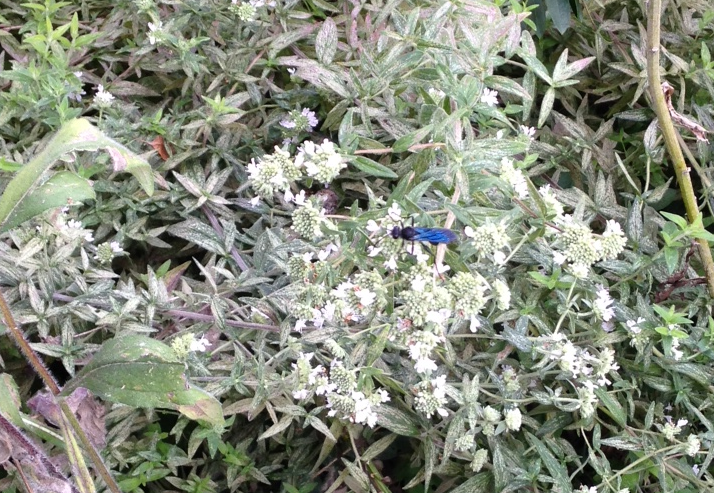
I’ve been seeing what I thought was a blue wasp on my mountain mint, but couldn’t get one to hold still long enough to be photographed. This evening I finally got a shot where you can definitely see his/her “blueness.”
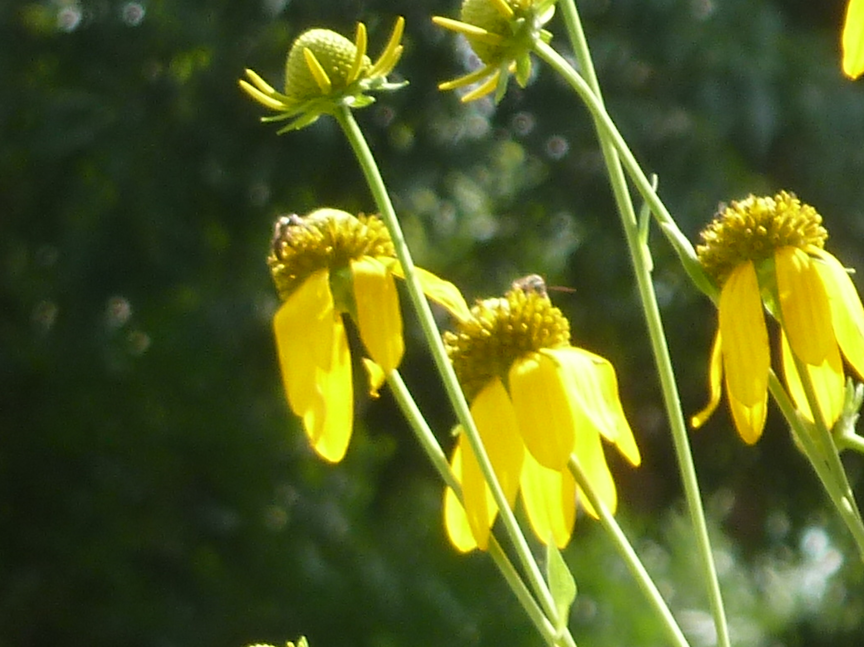
At last (late July – early August) the green-headed coneflowers (GHCF) — Rudbeckia lacinata — are blooming.
By now (08/01/14) the spring bloom of the garden is almost totally gone. The boneset is blooming throughout and the GHCF are standing tall at the back. (In another post I’ll discuss the current “weedy” state of the garden.)
The Garden as of 08/01/14
Whereas the Monarda attracted large bees, the GHCF attacts tiny bees. Here’s a view of the GHCF closer up in late July. Although there are a swarm of insects on the flowers, you can’t make them out in this photo.
Green-headed Coneflower Closer Up
In this REALLY close-up view, not quite in focus, you can see 3 little bees if you look carefully.
Close-up with 3 Tiny Bees
Finally, in this short video, you can see some bees buzzing around the flowers (you may need to watch it a couple of times to be sure to catch the bees — if you’ve ever had a visual field test this is a little bit like that):
I’m not sure if my mountain mint (given to me by my friend Suzette) is Virginia Mountain Mint (Pycnanthemum virginianum) or some other mountain mint. It comes into bloom in July and likes full sun. Bees (particularly small ones) and wasps adore it. Getting a picture of these fast-moving insects is practically impossible.
In this picture you can spot at least 3 small insects …..
Mountain Mint with Bees
….. A second later, the bee at upper left fully revealed its “greeness:”
Mountain Mint with Green Bee
Suzette keeps planting more mountain mint and keeps getting even more bees and wasps. We’ve wondered: if everyone planted mountain mint in their yard, would the number of bees and wasps keep expanding indefinitely??
One of my all-time favorite flowers is Rudbeckia triloba, known as “thin-leaf coneflower” or “brown-eyed susan.” It blooms late mid-summer. I love masses of them. If you stare into their faces, as in this photo, you can become a little hypnotized and imagine they are cheerfully looking back at you.
Rudbeckia triloba (thin-leaf coneflower)
Like other Rudbeckia, this one swarms with bees, in this case tiny bees. This greatly enlarged photo shows 2 such little bees.
Today I took a walk around my garden to see what I could photograph. When I got to the goldenrod, I saw a butterfly. Butterflies have been extremely scarce this summer so I immediately tried to get a picture of this one, though I didn’t know its identity. When I looked at the photo on my computer, this is what I saw:
Olive Hairstreak on Goldenrod
According to my Audubon Society Field Guide to North American Butterflies, this is an Olive Hairstreak in the category of “Gossamer Wings.” It’s host plant is Eastern Red Cedar. I am fortunate to have a couple of those trees in my yard. — Robin
At mid-July, much of my garden is going to seed already — particularly the Daisy Fleabane is mostly brown now. The goldfinches are still all over it and for all I know the fleabane may be an important source of seed for them so I intend to leave it there.
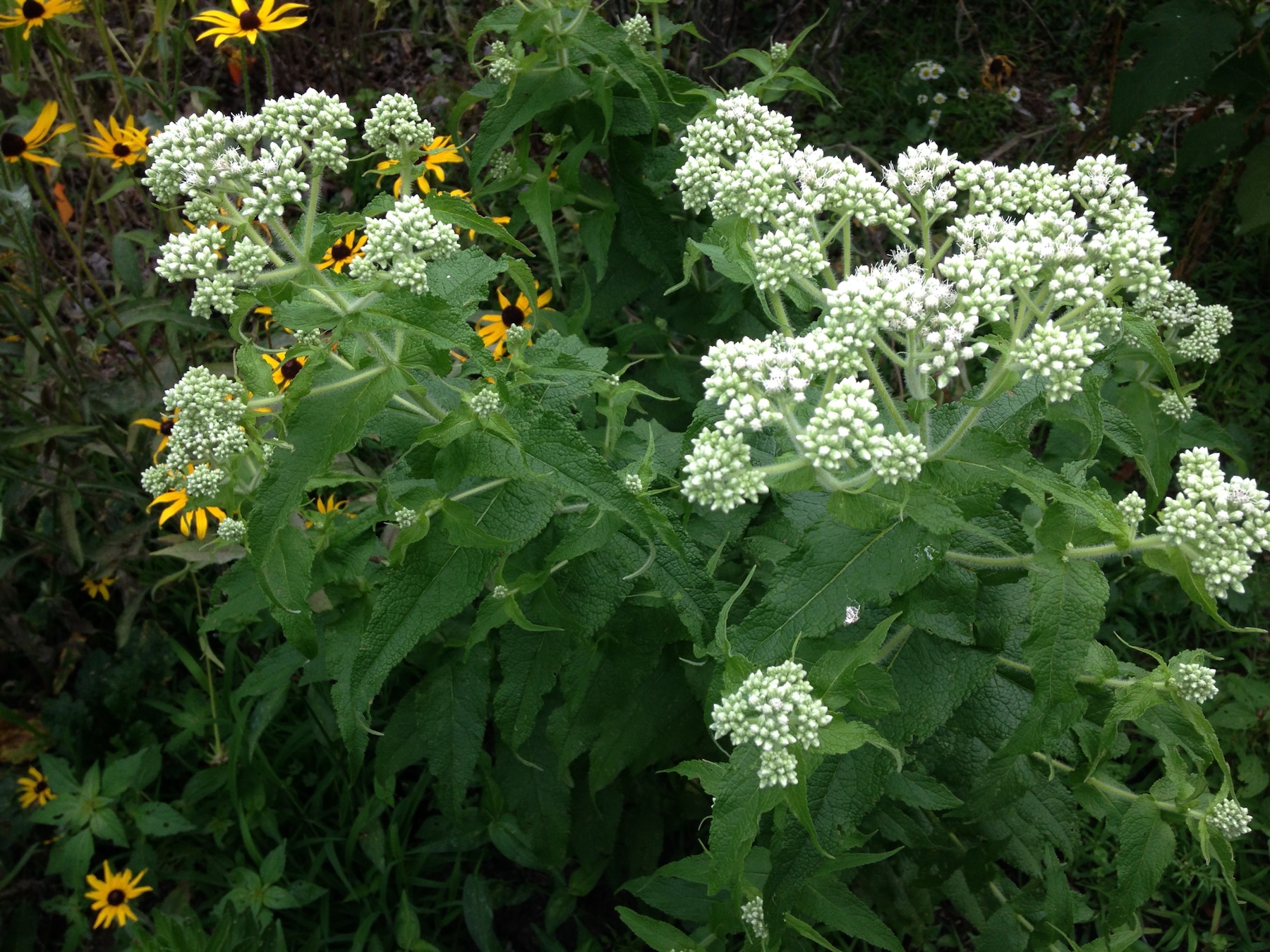
On the other hand, the boneset is coming into bloom at this time. I have it throughout my garden where it has self-seeded.
Boneset Coming into Bloom Mid-July
Yesterday I was very pleased to see a couple of butterflies flying through the garden and landing on the boneset. I THINK they were Spicebush Swallowtails. I’ve seen almost no butterflies at all this year so their appearance is very appreciated. I knew they had to be around because I have Spicebush Swallowtail caterpillars on my spicebushes but had not seen any adults yet.







 FROM WEEDS TO BEES