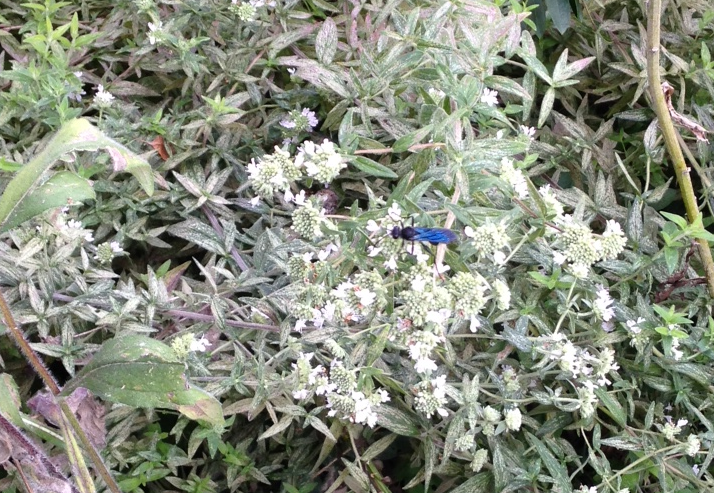
I’ve been seeing what I thought was a blue wasp on my mountain mint, but couldn’t get one to hold still long enough to be photographed. This evening I finally got a shot where you can definitely see his/her “blueness.”
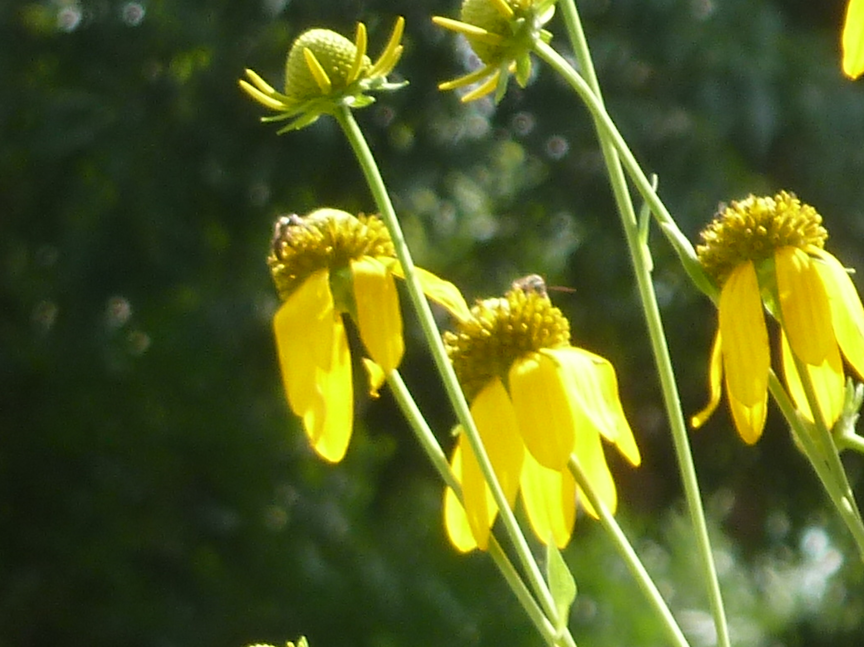
At last (late July – early August) the green-headed coneflowers (GHCF) — Rudbeckia lacinata — are blooming.
By now (08/01/14) the spring bloom of the garden is almost totally gone. The boneset is blooming throughout and the GHCF are standing tall at the back. (In another post I’ll discuss the current “weedy” state of the garden.)
The Garden as of 08/01/14
Whereas the Monarda attracted large bees, the GHCF attacts tiny bees. Here’s a view of the GHCF closer up in late July. Although there are a swarm of insects on the flowers, you can’t make them out in this photo.
Green-headed Coneflower Closer Up
In this REALLY close-up view, not quite in focus, you can see 3 little bees if you look carefully.
Close-up with 3 Tiny Bees
Finally, in this short video, you can see some bees buzzing around the flowers (you may need to watch it a couple of times to be sure to catch the bees — if you’ve ever had a visual field test this is a little bit like that):
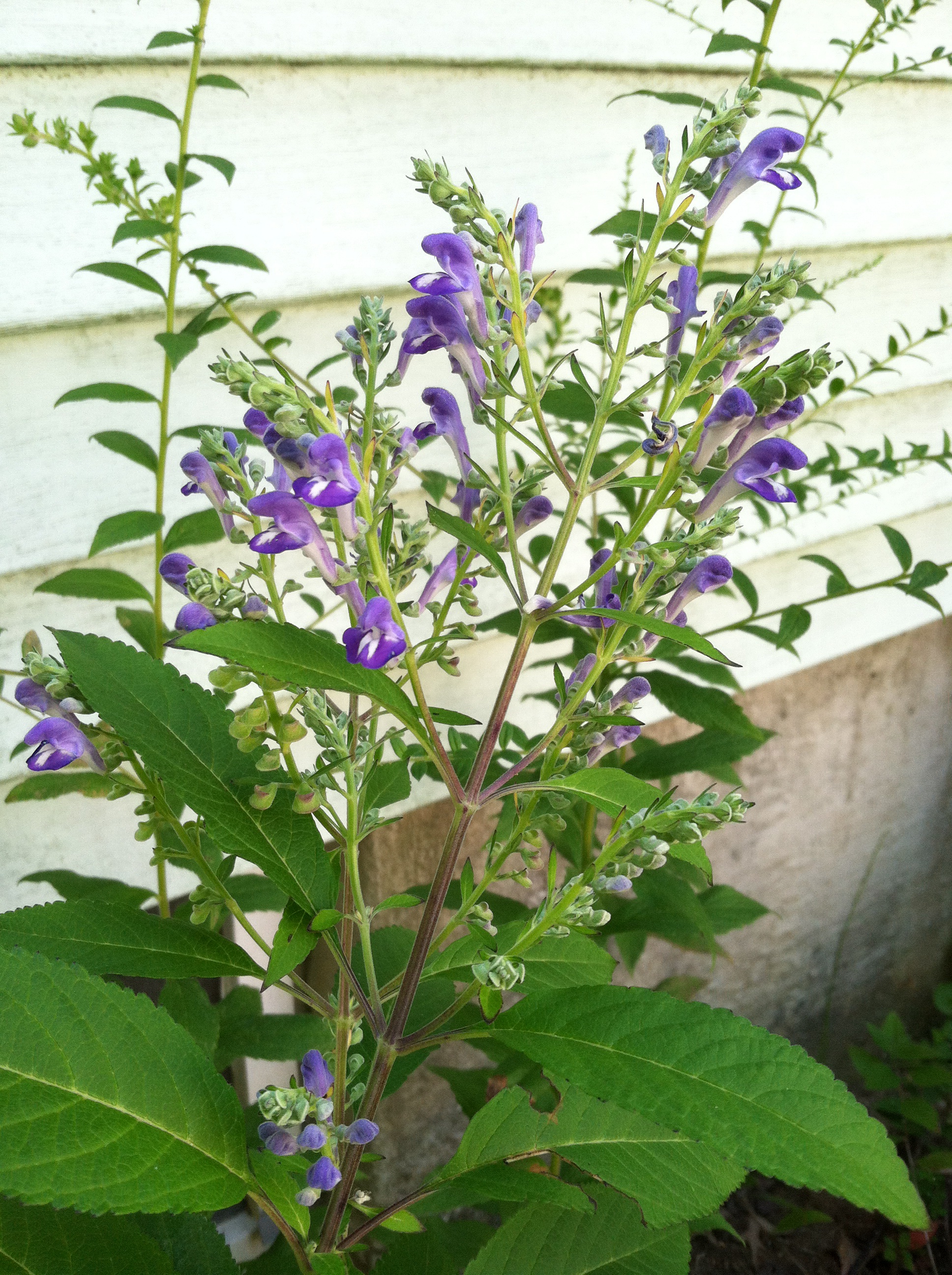
My hoary skullcap is coming into bloom! This is its third year and the best it has ever looked. The bumblebees and sweat bees seem to like it, too! I have no idea how it got its unusual name, but it sure makes it an easy one to remember!
I’m not sure if my mountain mint (given to me by my friend Suzette) is Virginia Mountain Mint (Pycnanthemum virginianum) or some other mountain mint. It comes into bloom in July and likes full sun. Bees (particularly small ones) and wasps adore it. Getting a picture of these fast-moving insects is practically impossible.
In this picture you can spot at least 3 small insects …..
Mountain Mint with Bees
….. A second later, the bee at upper left fully revealed its “greeness:”
Mountain Mint with Green Bee
Suzette keeps planting more mountain mint and keeps getting even more bees and wasps. We’ve wondered: if everyone planted mountain mint in their yard, would the number of bees and wasps keep expanding indefinitely??
This picture somehow got lost from my previous post. Some of the pots (the big ones in back row) are my house plants that I have had for years and bring out every summer. They always get new growth then. The 2nd from left in back row is almost 30 years old. The flowers in front include a begonia, some daisies, a geranium, and something I can’t remember.
The introduction to our blog mentions that some of us have chickens, and that would be me. I started keeping a small flock a few years ago after reading too many times about the horrible conditions of commercial poultry operations. I figured the least I could do is provide a small number of chickens with a better life than that. Mine have free range of the yard from mid-day until they decide to return to the roost at nightfall. (Our three dogs use the yard in the morning. Since two of them are bird dogs, we have never let the dogs and chickens mix.) Pictured above are Dana (left) and Amy. Dana is an Aracauna and gives us beautiful blue eggs. Amy is a barnyard chicken and is our long-time best layer. Her eggs are brown and have big dark yellow yolks. In addition to eggs, they give us nice pooped-on straw for the compost pile, so I make sure they get their fill of lettuce from the vegetable garden. Oddly enough, they do not like spinach.
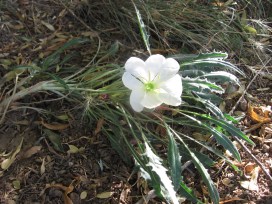
At the Idaho Native Plant Society sale, someone told me that most people don’t care for the evening primrose. So, always rooting for the underdog, I bought four of them. The leaves do lay on the ground in a weird way, and the blooms – which come out at night – last just one day, but I still think they are pretty. Also to their credit, they don’t like much water. The flowers on my plants are either white or a very pale pink.
One of my all-time favorite flowers is Rudbeckia triloba, known as “thin-leaf coneflower” or “brown-eyed susan.” It blooms late mid-summer. I love masses of them. If you stare into their faces, as in this photo, you can become a little hypnotized and imagine they are cheerfully looking back at you.
Rudbeckia triloba (thin-leaf coneflower)
Like other Rudbeckia, this one swarms with bees, in this case tiny bees. This greatly enlarged photo shows 2 such little bees.
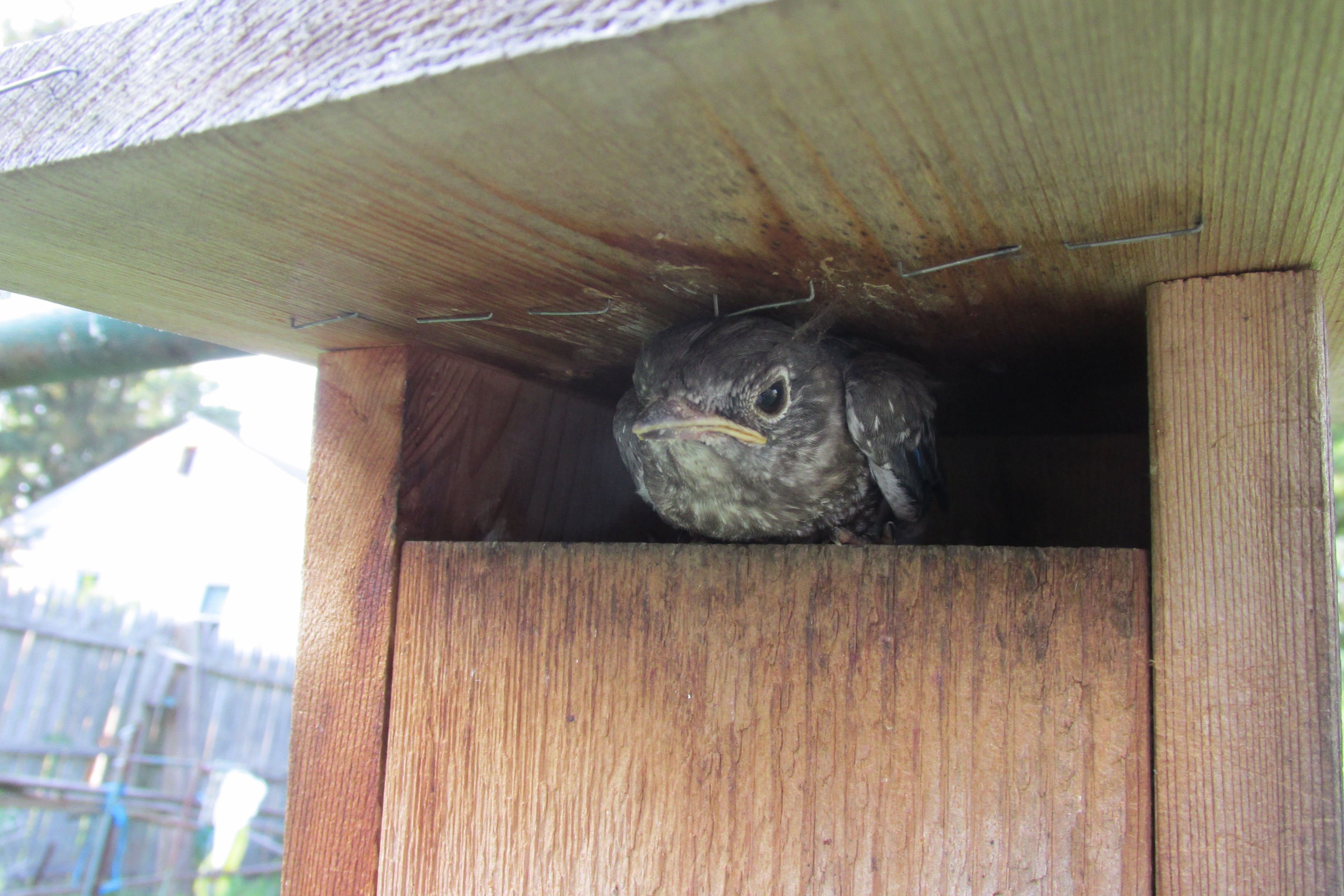
My bluebird box in the backyard has bluebirds nesting in it this year! Typically, they will raise 2 or 3 broods in a season. These are pictures taken the day before the first brood fledged. Have you ever seen such determination?
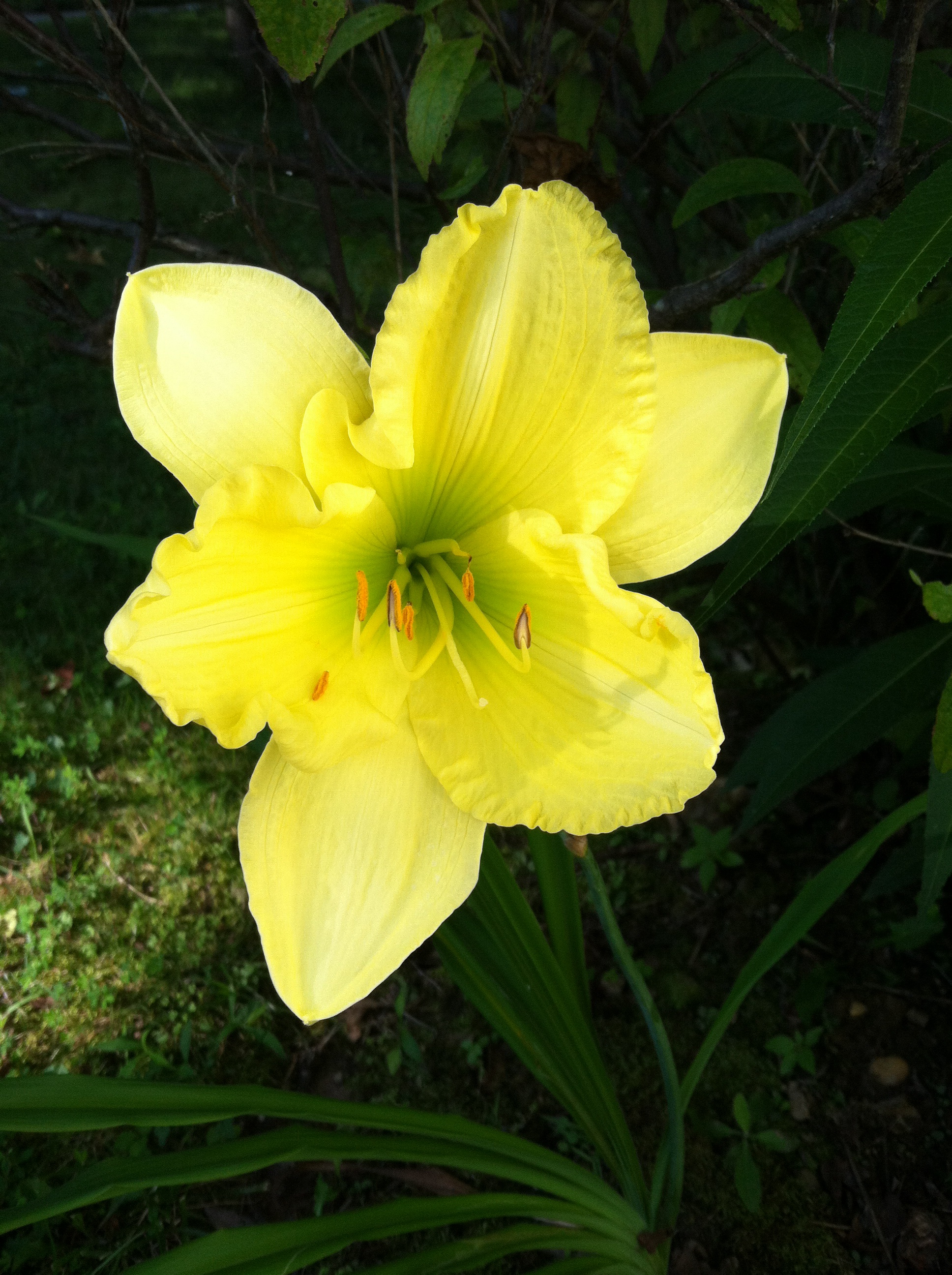
A few years ago, I went to a flower show with a friend where I was given a “freebie” lily bulb in a plastic bag. I had no idea what it was or what it would look like, but I took it home and planted it. That year it grew, but didn’t bloom, but the next year it was stunning! Since then I have found that it doesn’t bloom every year, but when it does, it is gorgeous! Each blossom lasts only one day, then a couple days later another one opens. It’s not a native, but I love this lily!









 FROM WEEDS TO BEES