I’ll start with the “pretty” stuff. I have a late-blooming goldenrod cultivar of some sort that I bought at a nursery last year. I don’t quite trust cultivars but this one seems to be attracting insects like crazy, so I guess it is OK. I think the following picture shows a “Soldier Beetle.” In fact, on looking at the picture more closely, I think there are TWO of them, one on top of the other.
Insect on Goldenrod
More bumblebees on the Sedum:
Bumblebees on Sedum
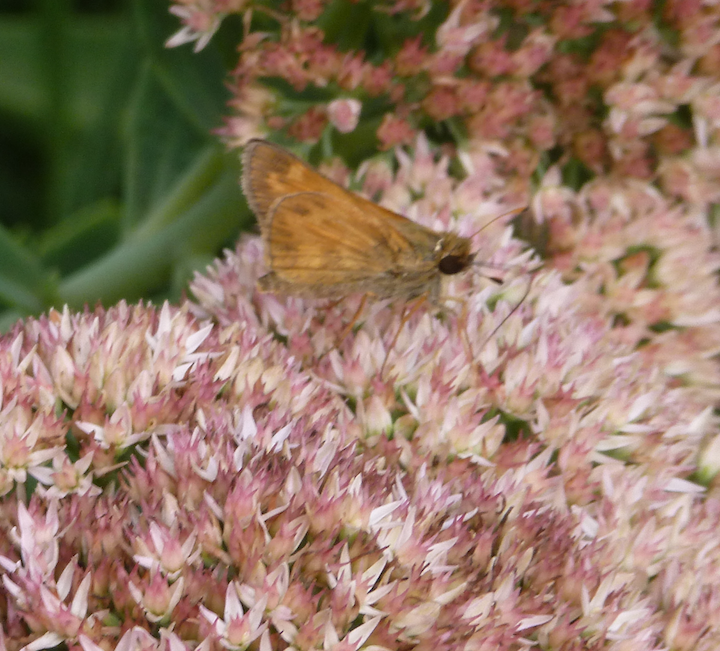
An unidentified skipper on the Sedum?
Skipper on Sedum?
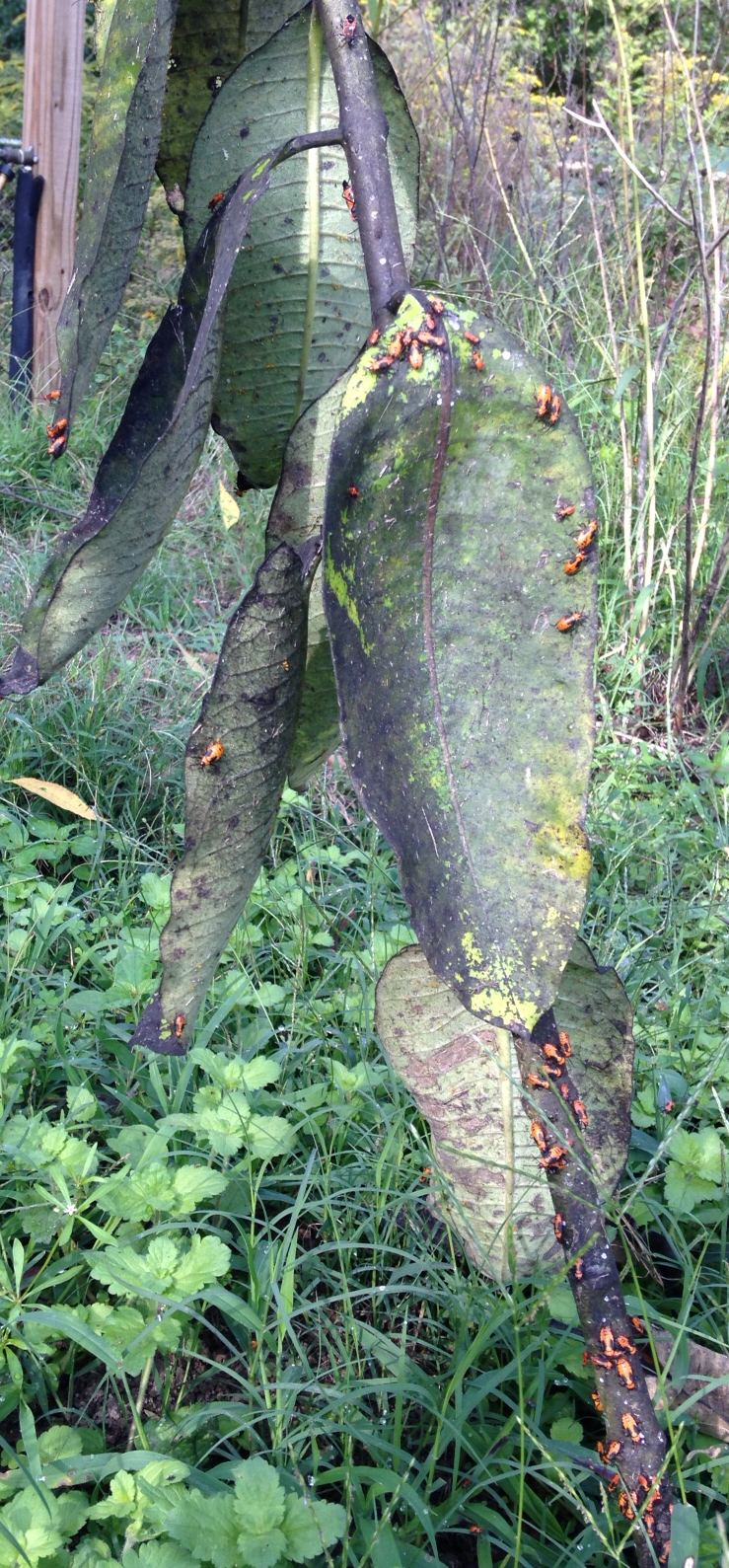
Finally here’s the not-so-pretty (well, really gross) picture that I took just for you, Wendy.
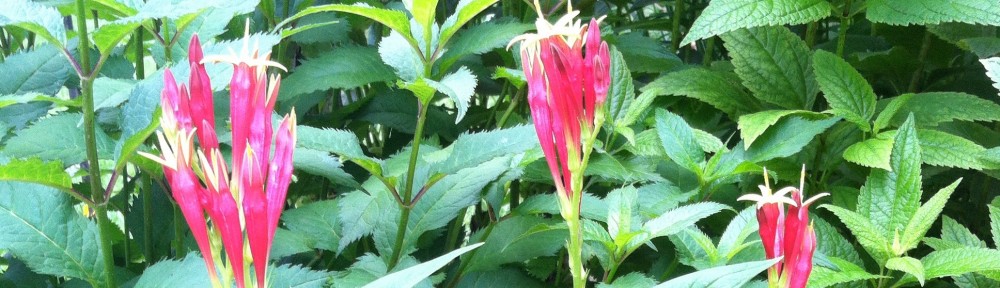
Look what I found growing among all the weeds in my “garden.” It’s the Obedient Plant (Physotegia virginiana) that I planted last year and thought had just disappeared. For some reason I’ve never been able successfully to grow Obedient Plant (I’ve planted it several times) even though friends of mine call it “Disobedient Plant” because it spreads so aggressively.
Obedient Plant
I had to pull a few weeds just to get this picture. Believe it or not my intention is to get the whole “garden” weeded by winter.
Even though it’s a non-native, I’ve always had a soft spot in my heart for sedum, because the bees and butterflies love it. It provides a late-summer nectar source. I know there are many different species of sedum but I don’t know exactly what I’ve got. I have 3 different ones in 3 different parts of my yard.
Lately I’ve been seeing more butterflies on my sedum than on my butterfly bush. Here are a couple:
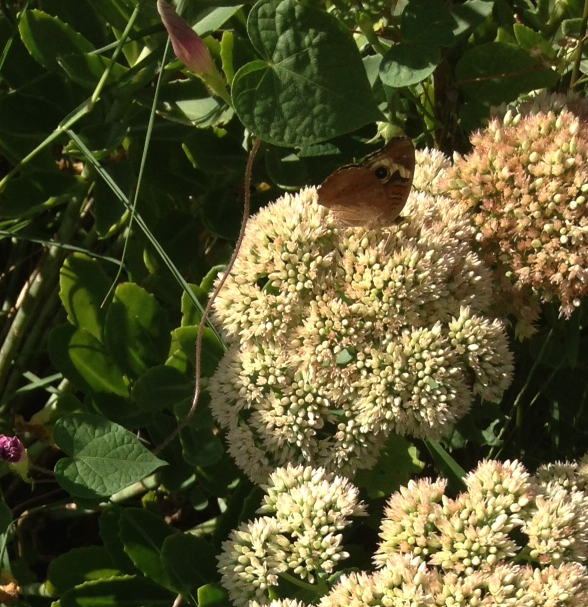
This Common Buckeye refused to keep its wings open long enough for me to get a good photograph, so I had to be satisfied with one with the wings closed:
Common Buckeye
This Painted Lady was just about as difficult to photograph. I don’t really know if it is a Painted Lady or an American Lady. According to my Life Cycles of Butterflies book, you have to count the number of eyespots on the underside of the lower wing to tell the difference. You can see it’s in the company of 3 different bees and another small butterfly I can’t identify.
Although they are well past blooming and practically all petals have dropped, the green-headed coneflowers are still acting as a food source. Yesterday I tried to get a picture of a goldfinch in these flowers with my smart phone, but was unable to do it. This morning I went armed with my “real” camera, and was able to get this picture with the lens zoomed to its limit.
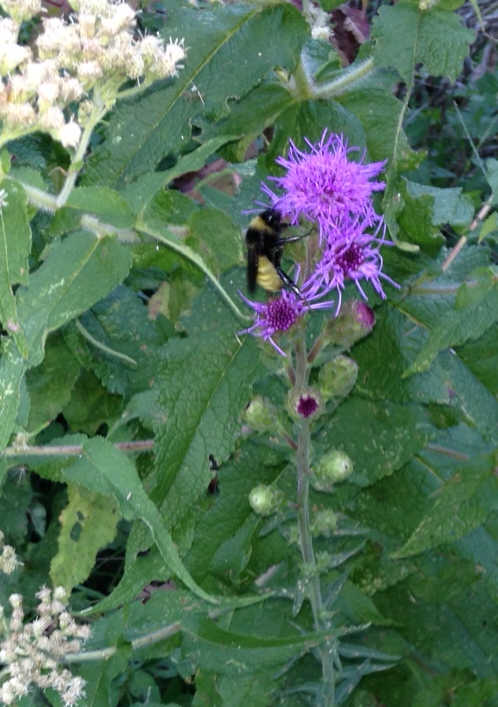
This spring I planted some bare root Northern Blazing Star — Liatris scariosa. It has come up strong and is just now starting to bloom. Last evening I saw that a bumblebee had already found it:
Bumblebee on Northern Blazing Star
Undoubtedly there will be more pictures to follow.
My sneezeweed has been coming into bloom for a couple of weeks now.
Sneezeweed
I count at least 7 tiny bees in this photo.
You can understand why its Latin name is Helenium autumnale. Most of my other flowers are done blooming for the year. Next year I plan to plant a lot more sneezeweed throughout my “meadow” garden so there will be more late summer color and nectar source for the tiny solitary bees.
My yard is so quiet now except for the clatter of the cicadas and the tiny twitter of the ruby-throated hummingbirds as they visit my feeders to tank up before their migration south. The bluebird family visits less and less frequently to indulge in my mealworms, and I noticed today that Mr. and Mrs. BB’s feathers are starting to look a little bedraggled. I hope they’ll be back next year!
On a more cheerful note, some of my late-summer flowers are blooming! Besides my hoary skullcap, the cardinal flowers (lobelia cardinalis) are a bright crimson, and my blue lobelia (lobelia siphilitica) is very popular with the bumblebees.
The cardinal flowers and blue lobelia are favorites of the bees. Look closely and you might see a bee on the blue lobelia!
Blue lobelia up close.
A new flower I tried this year, nodding onion, has decided to bloom after it sat all summer doing nothing and I had about given up on it!
Nodding onion. It’s hard to get a good picture because it keeps nodding!
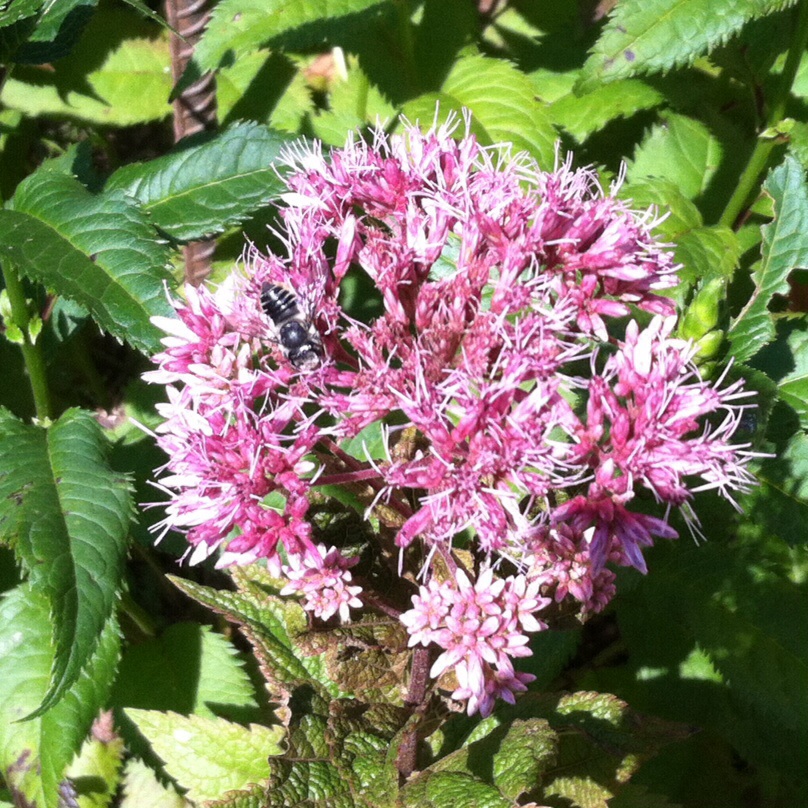
The bees are still all over the few remaining blossoms of my joe pye, which is pretty much finished for the year after a hot, dry spell.
Joe pye with bee. This patch was a-buzz all summer!
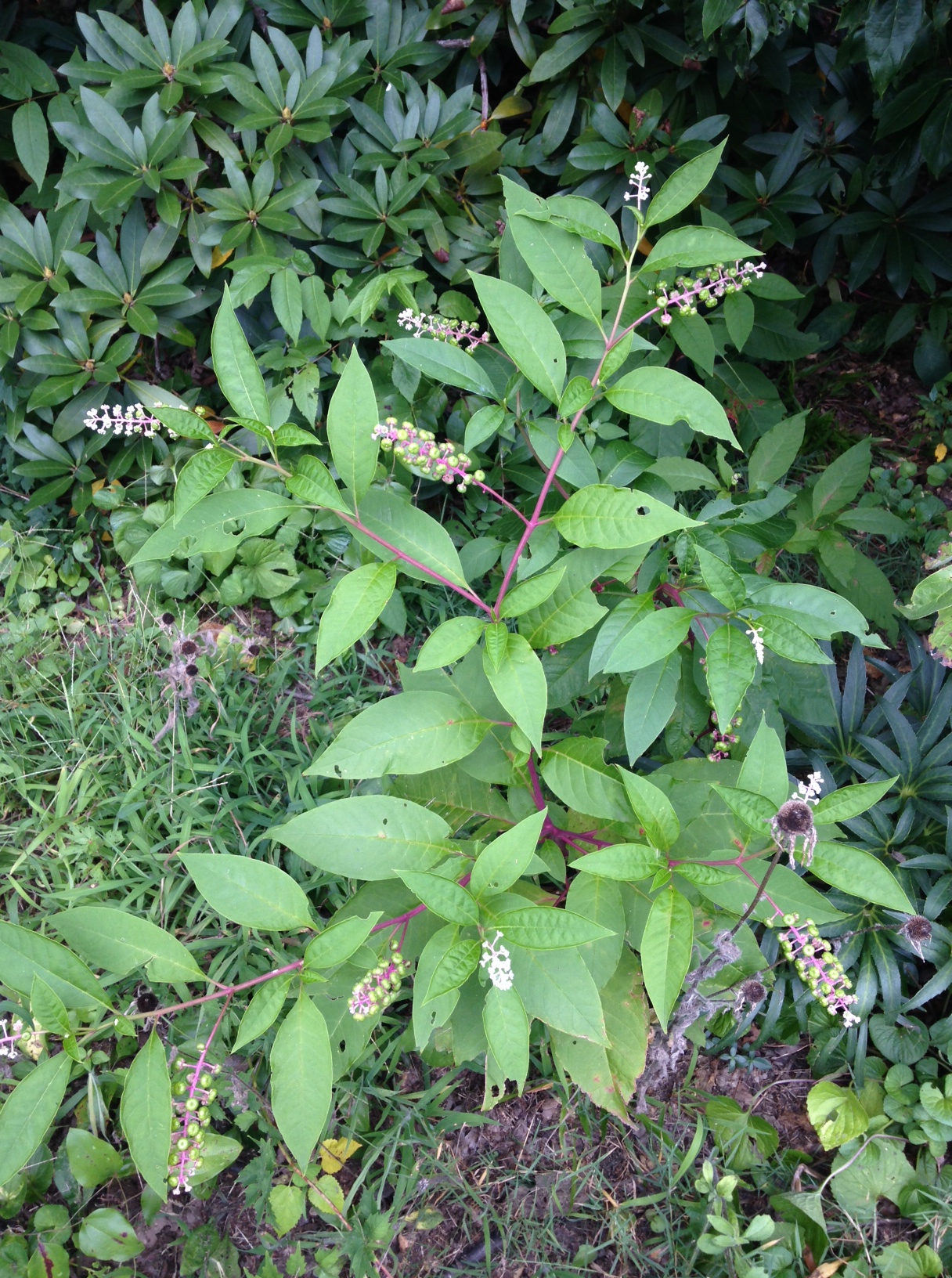
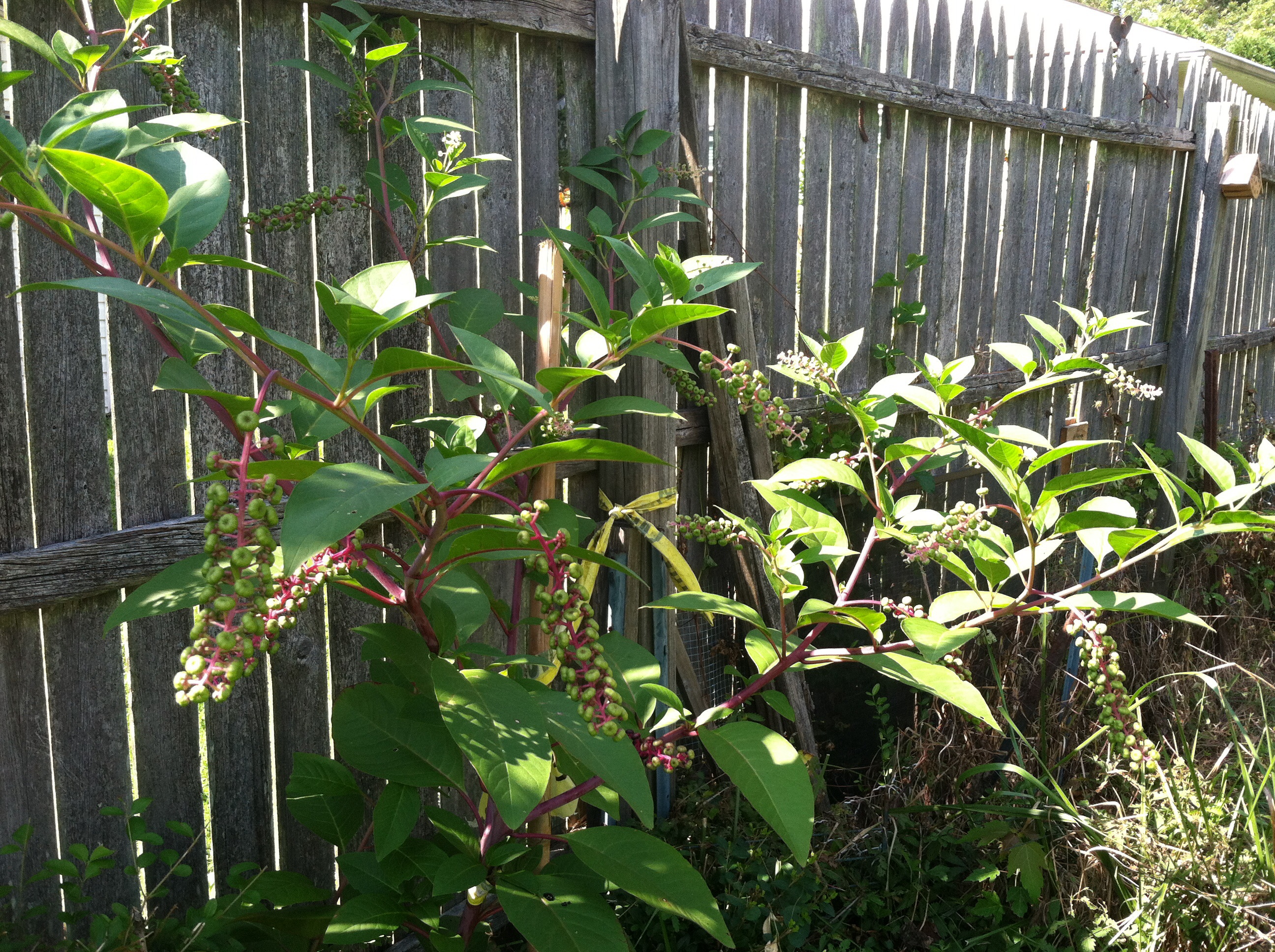
My pokeberry “tree”. Birds LOVE pokeberries, and I have been nurturing this one all summer. They’re finally starting to ripen.
I’m still waiting, somewhat impatiently, for my three varieties of goldenrod to bloom, but they just aren’t quite there yet. A few more late-bloomers have yet to put on their show, and I’m really looking forward to seeing them–more later!
Here again is Deb’s delightful video of a bumble bee foraging on some swamp milkweed:
Wouldn’t it be terrible if the nectar this bee is collecting had somehow been poisoned so as to be toxic to the bee and the bee’s hive?*
Incredibly, this has become a real possibility with the worldwide increasing use of neonicotinoids, systemic pesticides that are absorbed into the plant vascular system and can accumulate in the plant’s nectar and pollen.
In 2014, Common Dreams reported that an examination by Friends of the Earth found that more than half the plants being sold at major garden retailers as “bee-friendly” have been treated with neonicotinoids. (*Deb contacted the Delaware Nature Society from whom she purchased the milkweed in the video above and they assured her it had not come into contact with any neonicotinoids.)
Neonicotinoids are applied by many methods including foliar spraying, soil drench, seed coating, and trunk injections for trees.
The following information comes from a report by the Xerces Society for Invertebrate Conservation:
As of 2012 neonicotinoid pesticides had been applied to hundreds of thousands of acres of farmland. They persist in the soil and plants for very long periods of time (months and years). Measurable amounts of residues are found in woody plants up to six years after application. Untreated plants may absorb residues in the soil from the previous year. Neonicotinoids applied to crops can contaminate adjacent weeds and wildflowers.
It has been suggested that seed treatments may be less harmful than other application methods because concentration of the insecticide decreases over time as the biomass of the growing plant increases. However…. studies examining repeated use of seed-treatments over time noted that untreated sunflowers absorbed residual imidacloprid from the previous year’s treated sunflower plantings. Based upon these findings, annual plantings of seed-treated crops may lead to increased residue levels that may pose more of a risk to bees, since residues from previous seasons remain.
Products approved for home and garden use may be applied to ornamental and landscape plants, as well as turf, at significantly higher rates (potentially 120 times higher) than those approved for agricultural crops.
Neonicotinoid residues found in pollen and nectar are consumed by flower-visiting insects such as bees. Concentrations of residues can reach lethal levels in some situations.
Direct contact with foliar sprays is hazardous to pollinators and foliar residues on plant surfaces remain toxic to bees for several days. Honeybees exposed to sublethal levels of neonicotinoids can experience problems with flying and navigation, reduced taste sensitivity, and slower learning of new tasks, which all impact foraging ability.
Laboratory studies demonstrate that the neonicotinoids imidacloprid and clothianidin are highly toxic to bumble bees. Bumble bees exposed to sublethal amounts of neonicotinoids exhibit reduced food consumption, reproduction, worker survival rates, and foraging activity.
Evidence has not been obtained for a direct link between neonicotinoids and Colony Collapse Disorder (CCD). However, research suggests these chemicals may make honey bees more susceptible to parasites and pathogens implicated as a causative factor in CCD.
In 2010, 2012, and again in 2013 following the EU ban, beekeepers and environmentalists called on EPA to impose similar bans. The EPA has rebuffed these calls.
The story of the EPA approval of clothianidin is illustrative and informative. In 2003 EPA granted a “conditional” registration to this chemical based on the contingency that a study be performed on its safety. The study was to be performed by none other than Bayer, the pesticide’s manufacturer. In 2010 a leaked memo indicated the study was fatally flawed.
According to beekeeper Jeff Anderson, who has testified before EPA on the topic, “The Bayer study is fatally flawed. It was an open field study with control and test plots of about 2 acres each. Bees typically forage at least 2 miles out from the hive, so it is likely they didn’t ingest much of the treated crops. And corn, not canola, is the major pollen-producing crop that bees rely on for winter nutrition. This is a critical point because we see hive losses mainly after over-wintering, so there is something going on in these winter cycles. It’s as if they designed the study to avoid seeing clothianidin’s effects on hive health.”
Even more troubling evidence is coming to light indicating that neonicotinoids are poisoning other species in addition to bees:
A recent studypublished by Dutch scientists establishes an additional indirect link between neonicotinoid use and insect-eating birds. The report provides evidence that these pesticides are indirectly hurting larger creatures by reducing insect prey populations such as mosquitoes and beetles.
Another report by the Task Force on Systemic Pesticides states that terrestrial invertebrates such as earthworms can be adversely affected by low or acute (i.e. ongoing) exposure to neonicotinoids, making them highly vulnerable at field realistic concentrations – i.e., the concentrations which can be found in agriculture.
Still another meta-analysis of systemic pesticides by IUCN (the International Union for Conservation of Nature) confirms that they are causing significant damage to a wide range of beneficial invertebrate species, e.g. bees, butterflies and earthworms, and are a key factor in the decline of bees. They go on to state, “Neonics are a nerve poison and the effects of exposure range from instant and lethal to chronic. Even long term exposure at low (non-lethal) levels can be harmful. Chronic damage can include: impaired sense of smell or memory; reduced fecundity; altered feeding behaviour and reduced food intake including reduced foraging in bees; altered tunneling behaviour in earthworms; difficulty in flight and increased susceptibility to disease.”
Some of the retailers found to be selling neonicotinoid-tainted garden products are attempting to correct the situation. Thus, Home Depot has said they plan to ban or limit the use of neonicotinoid pesticides. They will require suppliers to start labeling any plants treated with these chemicals by the fourth quarter of 2014. They are also “running tests” to see if suppliers can eliminate these chemicals in their pant production.









 FROM WEEDS TO BEES